
The Drowned Inheritance
Sovereignty, water and the quiet machinery of the rare earth future

Investigation Minerals, Water, and the Question of Who Owns What
The Drowned Inheritance
Three floods in three years, two ranges of the oldest rock in America, a weapons grade uranium plant standing in the floodwater, and a quiet rule that has governed the nation’s mineral wealth for a hundred years. When the water rises, the title rises with it. A reckoning with rare earths, uranium, sovereign power, and the geology of who is permitted to own the future.
By Travis Spencer · Real Estate Mindset · Independent
Somewhere under the green water of Lake Buchanan, about twenty two miles northeast of the town of Llano, there is a hill that Thomas Edison once tried to buy. On a still afternoon the surface gives nothing away. Bass boats cross it. Families on rented pontoons trail their hands in the wake and never suspect that a hundred feet beneath them, in the cold and the silt, lies one of the greatest concentrations of rare earth minerals ever identified on the North American continent. The hill still has a name, though almost no one says it now. They called it Barringer Hill, and for one brief and luminous stretch around the turn of the last century it was among the most coveted pieces of ground in the United States.
Then the water came, and the question of who owned it answered itself.
This is a story about that question, and about the strange way it keeps answering itself the same way. It begins in the pink granite of central Texas and travels east into the drowned coves of southern Appalachia, and it turns on a single observation that almost no one writing about these floods has been willing to make out loud. Water moves minerals. And there is a machinery of law and money, older than any of us, that decides where the value finally settles. The machinery is quiet. It seldom makes the news. And over time it tilts in one direction only, which is upward, toward the sovereign, and away from whoever happens to be standing in the river when it rises.
The Hill the Titans Wanted
The pegmatite at Barringer Hill was found in 1887 by a farmer named John Baringer, who noticed heavy black crystals in the rock and had the wit to wonder what they were. The crystals were gadolinite, a greenish black ore of yttrium and the rare earths so scarce that until then it had turned up only in small quantities in Scandinavia and Russia. What followed reads less like mining history than like a fable about the dawn of the electric age. The mineral mattered because it glowed. Gadolinite could be worked into the filament of an incandescent lamp, and in the 1880s the men racing to light the world understood at once what that meant. Both Thomas Edison and George Westinghouse moved to acquire the hill. Edison’s company won out in 1889.
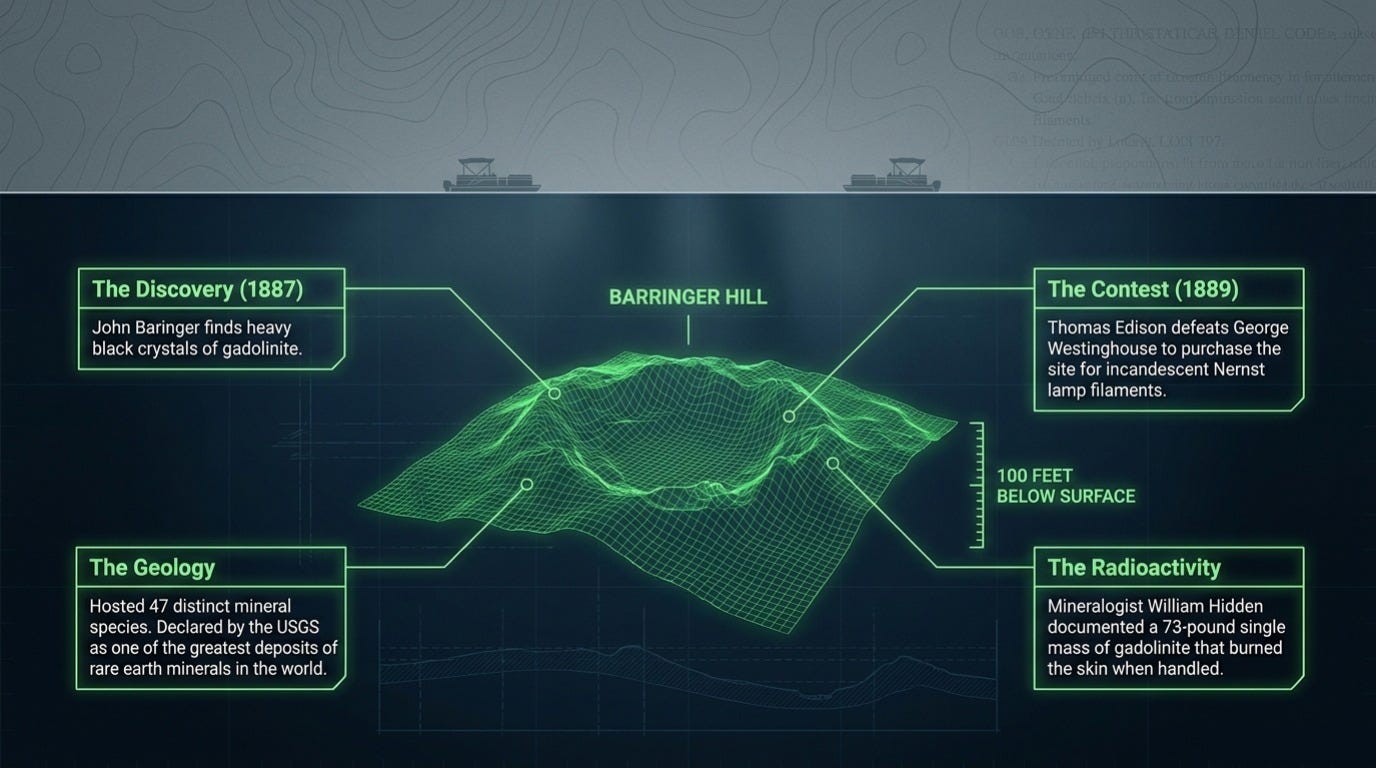
What they had bought, it turned out, was a geological marvel. The United States Geological Survey would later describe Barringer Hill as one of the greatest deposits of rare earth minerals in the world. It was the place where geologists first laid eyes on three minerals previously unknown to science, fergusonite among them. Across its short working life the hill gave up forty seven distinct mineral species. The mineralogist William Hidden, who worked the site and photographed himself beside a single mass of gadolinite weighing seventy three pounds, recorded that the richest ore threw off long radiating lines he learned to read as pointers to the best rock. He also recorded a reddening of the skin and a burning sensation when he handled it, which he attributed to a property of the stone then only dimly understood. It was radioactivity. The hill was hot.
For a time the rock fed the Nernst lamp, an early electric light whose glower used raw rare earth ore, and the German chemist Walther Nernst, who would one day win a place in the textbooks for the third law of thermodynamics, built his street lighting around it while working for Westinghouse. Then the technology moved on, as technology does. Newer lamps surpassed the Nernst design. The mining wound down to a few hundred pounds a year. And the hill, having briefly been one of the most important addresses in American industry, settled back into obscurity in the ranch country west of Austin.
It would not be left alone.
The String on the Money
Forty miles down the Colorado River, the same decades that emptied Barringer Hill of its purpose were filling up with a different ambition. Central Texas wanted to tame its river, a river that alternated, in the regional shorthand, between flood and drought with nothing reasonable in between. In 1931 a subsidiary of the national Insull utility empire began building the most ambitious dam yet attempted on the Colorado, a structure near Burnet meant for power and flood control both. The following year Insull collapsed into bankruptcy and the dam stood half finished, a wall of concrete going nowhere, its workers idled in the teeth of the Depression.
Here the story turns on a detail that ought to be famous and is not. The only money available to finish the dam was federal money. And the federal money came with a condition. It could be released only to a public agency that was created by, and owned by, the State of Texas. There would be no private dam. If Washington was going to pay to raise this water, the entity that held the water afterward would have to be a creature of the state.
So the state made one. In November of 1934 the Texas Legislature passed the act that created the Lower Colorado River Authority, a public body with the power to store and sell water, to generate electricity, and to hold the river. Construction resumed. The deliberate impoundment of the reservoir began in the spring of 1937. By 1938 the dam was complete, the lake was filling, and Barringer Hill, the hill that Edison had wanted, the hill the Survey called one of the greatest rare earth deposits in the world, lay beneath a hundred feet of water that belonged, along with everything it covered, to an agency owned by the State of Texas.
Follow the title as it moves, because the arc is the whole point. The rare earths began in private hands, fought over by the most powerful industrialists of the age. Federal money then entered the picture carrying a sovereignty clause: pay, but only to the state. A state authority was conjured into existence to receive what the money built. And then the water rose, quietly and on schedule, and carried the deposit out of private reach and into the keeping of the sovereign, where it remains to this hour. No court heard the case. No one was condemned.
The water did the work that lawyers usually do, and it did it without a hearing.
A note is owed here, in fairness, because the drama invites overstatement and the truth is better than the exaggeration. Barringer Hill was mineralogically extraordinary but it was never a mountain of bulk ore. The recorded production runs to perhaps twelve hundred pounds of gadolinite from the original workings and a few hundred pounds a year of rare earth minerals after that. Its greatness was in what it was and what it proved, the first sightings of new minerals, the contest between Edison and Westinghouse, the Survey’s superlative, and not in tonnage waiting to be dug. The honest description is the most significant rare earth deposit in the history of Texas, now drowned and held by the state. That is remarkable enough. It does not need to be a treasure chest.
What it needs to be understood as is a pattern. Because eight hundred miles to the east, in slower motion and on different rock that turns out to be the same rock, the pattern is repeating.
The Same Stone, Facing the Atlantic
In late September of 2024 the remnants of Hurricane Helene climbed into the southern Appalachians and broke open the sky. Among the places it ruined was Spruce Pine, North Carolina, a town of barely two thousand that happens to sit on the purest quartz deposit on earth. The world noticed Spruce Pine for a few anxious weeks, because the high purity quartz mined there is the irreplaceable vessel in which silicon is melted to make semiconductors, and the floodwaters that submerged the town threatened, for a moment, to put a crack in the supply chain of the entire digital age.
But the quartz, important as it is, was a distraction from the older and quieter inheritance buried in the same hills. Quartz is silicon and oxygen and nothing else. It carries no rare earths. The rare earths in this country lie a little to the southeast, in a belt of ground that geologists have known about for a century and the public has entirely forgotten. They called it the Carolina monazite belt, and it produced rare earths the way Barringer Hill never could have, by the patient sorting of rivers.
The deposits were placers, which is to say they were not veins of rock but concentrations of heavy mineral that flowing water had gathered and piled over geologic time. From 1887 to 1911 the streams of the Carolina Piedmont gave up monazite, a phosphate mineral freighted with cerium and lanthanum and neodymium and a measure of thorium, washed and graded and laid down in the gravel by the rivers themselves. The old mine records contain a detail that should make anyone covering a flood sit up. The placer operations were described as long lived precisely because of the gravel that floods kept bringing down. Floods did not destroy these deposits. Floods made them. The rare earths of the Carolinas are, by their very nature, a thing that moving water assembles.
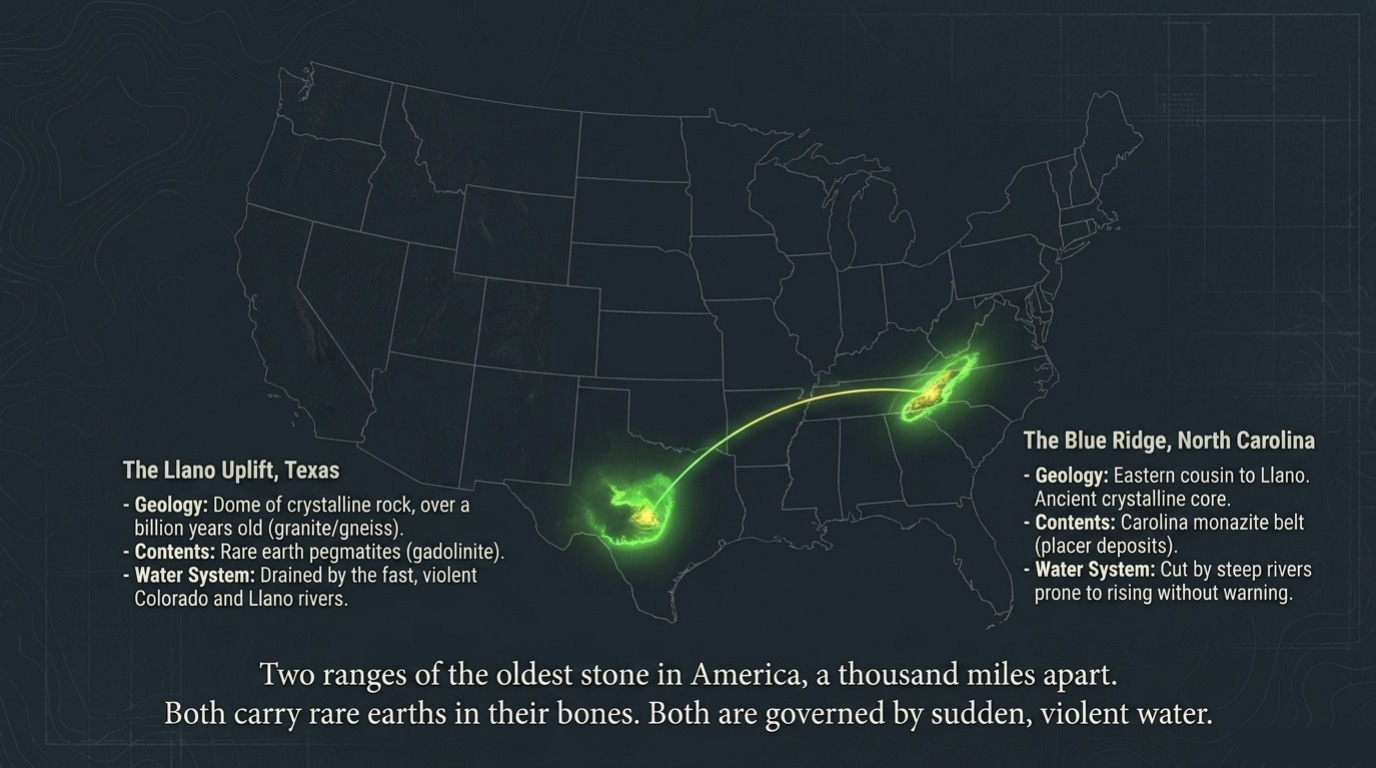
And the rock that the water was grinding to make them is the same kind of rock that holds Barringer Hill. This is the parallel that turns two news events into one story. The Llano country of central Texas sits on the Llano Uplift, a dome of crystalline rock more than a billion years old, granite and gneiss shot through with the rare earth pegmatites that gave us the drowned hill. The Blue Ridge that Helene drowned is its eastern cousin, an ancient crystalline core laced with the same kind of pegmatite and drained by the same kind of fast and violent river. Two ranges of the oldest stone in America, a thousand miles apart, each carrying rare earths in its bones, each cut by rivers prone to rising without warning. When such a river floods, it does what rivers have always done to such rock. It moves the heavy minerals downstream and sorts them and sets them down again.
The kinship is not a figure of speech. It is a single event. The crystalline core of the Llano country and the basement of the Blue Ridge were both forged in the Grenville orogeny, the mountain building collision of roughly a billion years ago that welded the interior of the continent together, and the geologists who study it place the Texas uplift and the southern Appalachian massifs in the same accretion along the old southern margin of North America. When they list the surviving exposures of that ancient orogen in the East, one of the names on the list is the French Broad, the river that drains the very mountains Helene drowned. The same floor of rock runs unbroken beneath both ranges, down in the dark under the younger cover, traced by deep seismic survey from the Appalachians toward Texas. The Texas hill country and the Carolina mountains stand, a thousand miles apart, on one continuous stone.
In the summer of 2025, on the fourth of July, one of those rivers rose.
What the Water Did
The flood that killed more than a hundred people in the Texas Hill Country is remembered, rightly, for its dead, and any account that loses sight of them has lost its way. The Guadalupe took the most lives. But the Llano River rose too, in Llano County, on the granite, and the footage from the crossing at Kingsland shows the water swallowing a familiar low slab in something like ten minutes. The state declared Llano a disaster county alongside the others and sent emergency money to its hospital. The river that drains the rare earth granite of the Llano Uplift had one of its violent days.
What a flood like that does to crystalline terrain is not a mystery. Heavy minerals, monazite and zircon and the rest, are dense, far denser than ordinary sand, and when the energy of the water falls they settle first and gather in predictable places, on the inside of bends, in the lee of obstructions, in the deep scour of the pools. This is the same hydraulic sorting that built the Carolina placers and concentrated the ore of a hundred other rivers. A flood of this size does not merely tear the land apart. It sorts it again. It strips heavy mineral concentrate from some reaches and rebuilds it in others. The science of tracing that movement is real, established, and equipped with a century of method, the very method by which the Survey mapped these deposits in the first place.
Here is the part that no one has done. In the months since these floods, the published study of the new sediment has been a study of poison, not of value. The peer reviewed work that came out of the Helene flood zone went looking for industrial contaminants and forever chemicals in the rivers, and found them. The agencies of both states have treated the freshly moved sediment as debris to be cleared, as a hazard to be carted off, governed by guidance on stream restoration and disposal. No one has run the heavy mineral assay on the new flood deposits. No one has followed the dense fraction downstream to see where the rivers chose to put it this time. The oldest economic question in mining, what did the water concentrate and where, has gone unasked in the one place and the one moment when it would have been simplest to answer. That silence is the real and defensible scandal here, and it is a great deal more interesting than any fantasy of buried treasure unleashed.
Because while no one is measuring what the water moved, a great many people are moving very fast to decide who will own the rare earths of the United States. And the answer they are arriving at is the same answer the water gave at Barringer Hill.
The Mineral That Glows
To understand why the rare earth story and a far darker story are the same story, you have to look closely at the mineral itself. The rare earths of these ancient rocks travel, overwhelmingly, inside a single host: monazite, a reddish phosphate that the rivers sort because it is dense and that industry covets because it is rich. Monazite is not only a rare earth ore. It carries, locked in the same crystal, between four and twelve percent thorium by weight, and a trace of uranium besides. The rare earths and the radioactive elements are not neighbors in this rock. They are the same grain.
That single fact explains things that otherwise seem unrelated. It explains how the government finds these deposits, because the thorium in monazite is faintly radioactive, and a plane flying a gamma ray spectrometer can read the glow of thorium from the air and map where the rare earths lie, which is exactly what the federal survey has been doing across both ranges, in one program, in the same years the floods were rearranging the mineral on the ground. The thorium betrays the rare earths from a thousand feet up. And it explains why the United States, sitting on real deposits, has struggled for decades to process its own, because separating the rare earths means handling and disposing of the thorium, and the nation’s one operating mine throws off kilograms of thorium for every ton of rare earth it refines, a radioactive burden that has helped keep American processing uncompetitive and dependent on a country willing to bear it.
And it explains the thing that turns this from an economic story into a strategic one. Thorium is not merely waste. It is fuel. Thorium two thirty two, struck by a neutron, becomes uranium two thirty three, which splits and sustains a chain reaction, which is to say the radioactive freight riding inside the rare earth mineral is itself a nuclear material. The rock that Edison wanted in order to make light, and that the modern world wants in order to make magnets, has always carried, in the same crystal, the makings of a reactor. The rare earth question and the nuclear question were never two questions. They were one mineral, and one continent’s oldest rock, all along.
One mineral. One continent’s oldest rock. The rare earths and the reactor fuel, locked in the same grain.
Which is why the most loaded place this whole pattern touches is not a rare earth mine at all. It is a uranium plant, on a river in the Tennessee mountains, two tenths of a mile from the water, that flooded in the same storm that drowned Spruce Pine.
The Plant on the Nolichucky
In the town of Erwin, in the Tennessee mountains just across the line from North Carolina, there is a plant that almost no one outside the valley thinks about and almost everyone inside it does. It is called Nuclear Fuel Services, it has run since 1959, and it is one of only two places in the United States licensed to store and process highly enriched uranium. It makes the fuel for the reactors that drive the Navy’s submarines and aircraft carriers. It takes Cold War stockpiles of weapons grade uranium and blends them down into fuel for power reactors. It sits, by the measure in its own federal records, two tenths of a mile from the Nolichucky River, about thirty feet above the water.
On the twenty seventh of September, 2024, the Nolichucky rose into the same catastrophe that was unmaking the Carolinas a few ridges away. The river’s flow that day, over the dam downstream, was reckoned at nearly twice the flow of Niagara. The plant did what such a plant is built to do in a crisis. It lost its power, suspended operations, locked its nuclear material in place under a plant wide stop movement order, and threw up sandbags and dikes along the production buildings, and when it was over the company and the regulator both said the material had stayed secure. That much is the system working.
But the river had already shown what water does to such a place. An offsite warehouse was destroyed, and its contents were carried away downstream, and among the things the flood took were containers marked, as the law requires, with the words fissile radioactive material. The company said the containers were empty and clean, and worked with the state’s emergency agency to chase them down the valley and bring them back, and the thing that lodges in the mind is the image of barrels labeled for the most controlled substance on earth bobbing down a flooded river, while a thousand feet away the same water tore through a plastics plant and swept eleven workers off their feet, several of whom never came home. The barrels were empty. That was not.
And here the story rhymes, exactly, with the rivers in Texas. Because the uranium in this picture did not arrive with the flood. It was already in the river. For more than a decade, independent scientists working with the Sierra Club have found enriched uranium in the Nolichucky and in the lake downstream of the plant, in ratios of one isotope to another that do not occur in nature and point to only one possible source. The water that the storm drove to a historic crest was already, on the quietest day, carrying the signature of what the plant releases. The flood did not create the contamination. It simply moved, all at once and violently, what the river had been moving slowly all along. The same hydraulic truth that sorts monazite in the Llano sorts the heavier news in Tennessee.
And the sovereign is gathering this rock too. In the autumn of 2025 the National Nuclear Security Administration awarded the plant’s parent company a contract worth a billion and a half dollars to rebuild, on a parcel beside the existing plant, a domestic capacity to enrich uranium for the nation’s defense, a capability the country had let lapse and now wants back inside its own borders and under its own hand. Uranium in the Blue Ridge, rare earths in the Llano, both being drawn back under sovereign control in the same eighteen months, on the same billion year old crystalline floor, under the same sign of water rising. The pattern does not care which element it is. It only cares which way the value moves.
The Doctrine of Rising Title
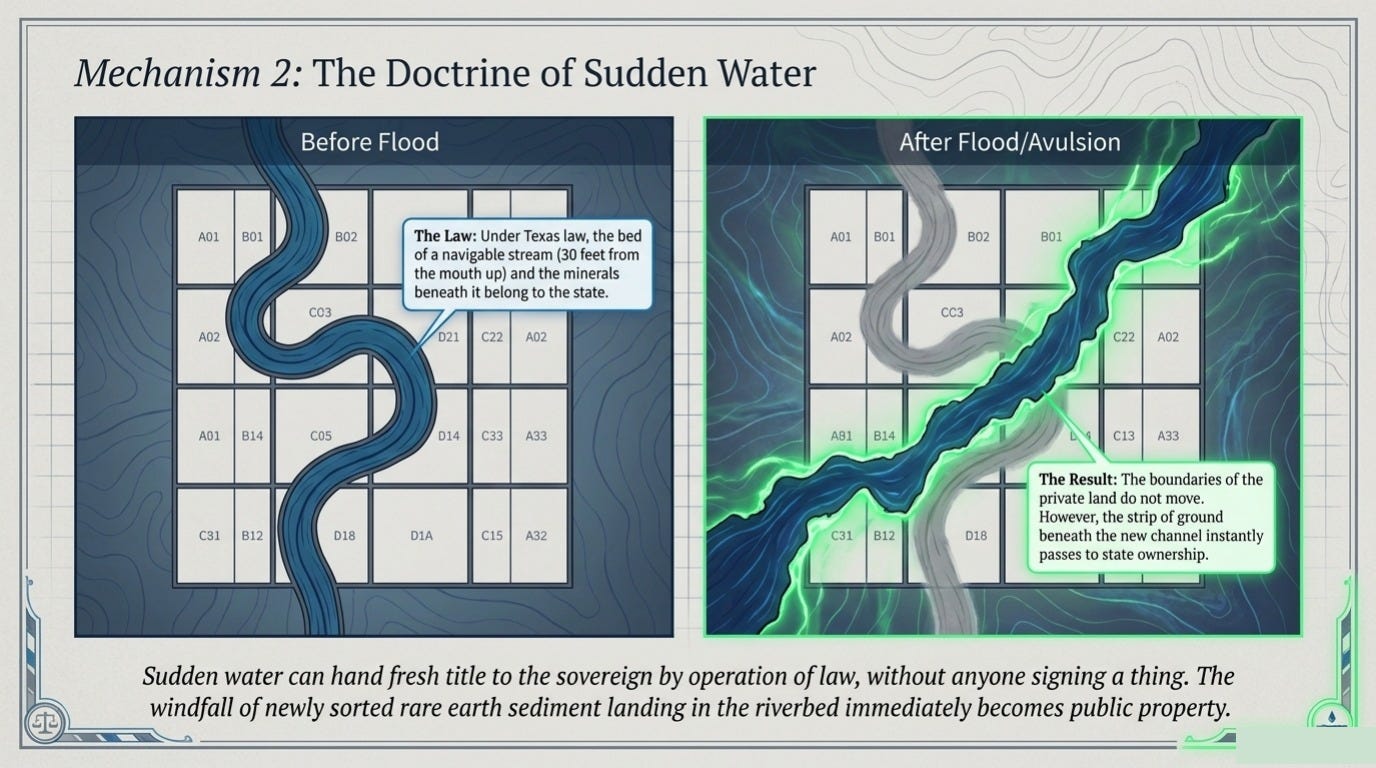
Begin with the riverbeds, because they are where the rule shows itself most plainly. Under Texas law, the bed of a navigable stream, and the minerals beneath it, belong to the state. The test is mechanical and ancient, a width of thirty feet from the mouth up, and it has the effect of vesting in the public a great latticework of riverbed across the state. The water that flows over it belongs to the state as well, held in trust for the people and managed, on the Colorado, by that same river authority that holds the drowned hill. When a flood reshapes such a river, the law has an answer ready. The boundaries of the private land do not move. But if a navigable river abandons its old channel and cuts a new one, the strip of ground beneath the new channel passes to the state. Sudden water, in Texas, can hand fresh title to the sovereign by operation of law, without anyone signing a thing.
The same gravity governs the eastern story, by other means. In North Carolina the state likewise owns the beds and the minerals of its navigable waters, with sweeping statutory power to lease them. And the dry land is no freer of the pattern. Beneath roughly forty one percent of Mitchell County, the very county that holds Spruce Pine, the mineral estate was severed from the surface and sold at public auction in 1951 to a single family of industrialists, a tract of fifty eight thousand acres that takes in a portion of the Pisgah National Forest itself. Three quarters of a century before Helene, the rights under the most strategically located ground in the region had already been gathered into private hands, and no flood touches a severance like that. Even the federal forests of the eastern mountains carry the quirk, having been assembled by purchase rather than carved from the public domain, so that the minerals beneath much of that federally managed land were never federal at all, but stayed with whoever reserved them.
And then there is the largest movement of all, the one happening in plain sight and at a speed that has no precedent. In the summer of 2025 the Department of Defense bought four hundred million dollars of stock in the only operating rare earth mine in the country and became, in a single stroke, its largest shareholder, the first time the federal government had ever taken a major ownership position in a critical minerals company. It was not the last. Within months the government had converted federal grants into equity in seven such companies, taking a tenth of the firm that is building the nation’s heavy rare earth supply at Round Top in far west Texas, a project that sits entirely on state land, carried by more than a billion and a half dollars of federal funding, its royalties owed to the Permanent School Fund, its jurisdiction routed around Washington and back to Austin. State land. State royalty. Federal money. Federal equity. One holder. A billion dollar magnet plant was steered to North Carolina on a federal partnership; a strategic reserve of refined minerals was stood up with ten billion dollars of public credit; the national stockpile, a creature of 1939, was refilled and ordered to hold sixteen of the rare earth elements; and in February of 2026 the government gathered fifty four nations in Washington to organize the whole effort against the country that controls the trade today. The architecture that drowned Barringer Hill is being poured again, on a continental scale, deliberately, in our own time.
The water moves the minerals. The machinery moves the title. And the title moves up.
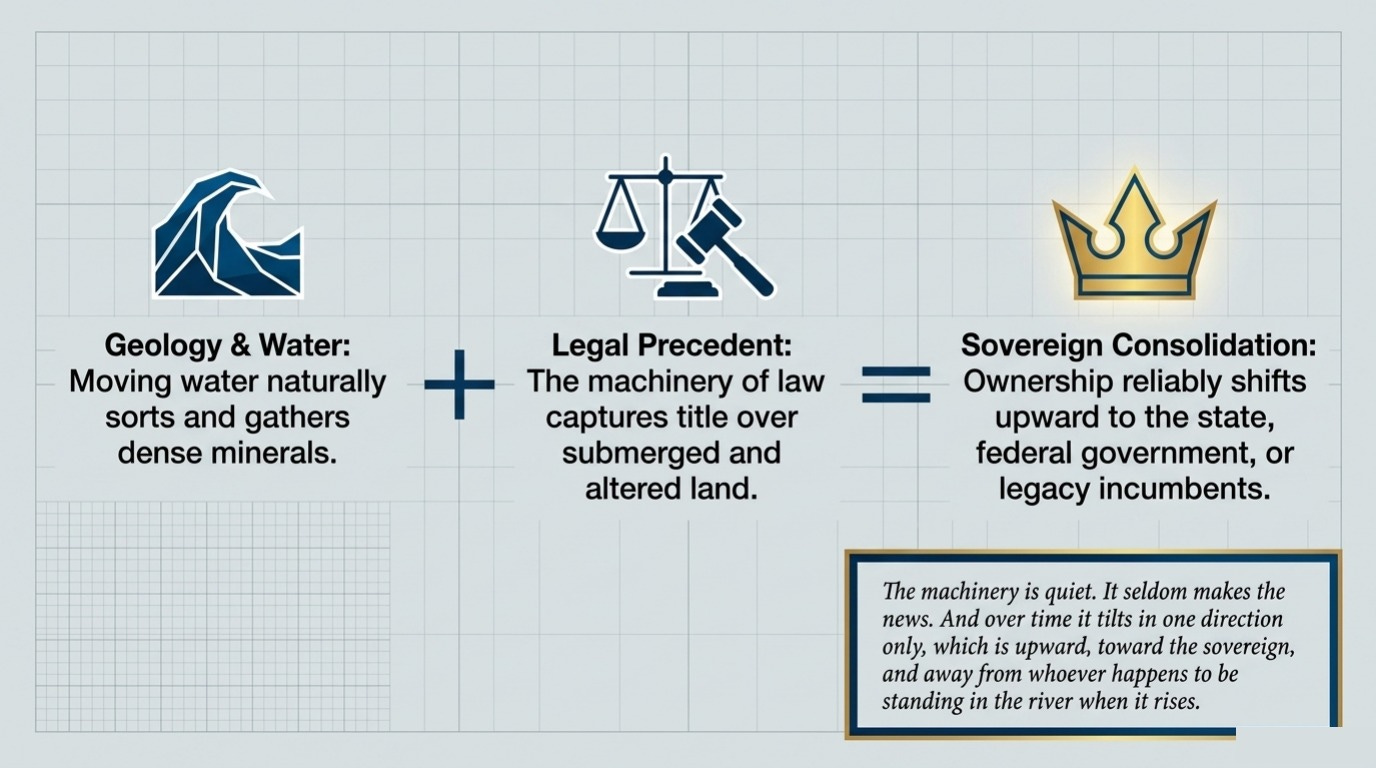
The rare earths are not being scattered to lucky landowners. They are being gathered, by statute and by reservoir and by appropriation, into the hands of states and river authorities and the federal government and the handful of incumbents who got there first.
The Rehearsed Flood
And then, one year almost to the day after the Guadalupe took its dead, the machinery got a full rehearsal.
In the small hours of the sixteenth of July, 2026, the sky over the Hill Country opened again. By three in the morning the forecasters had declared a flash flood emergency for Hunt and Ingram and Kerrville, the same names as the year before, and the city of Kerrville ordered its people to shelter in place and stay off the roads. The Guadalupe at Center Point rose thirty two feet in four hours. In Kerrville a man in his sixties called his neighbor at three in the morning to say the water was coming into his mobile home, and by the time the neighbor could reach him the home was afloat, and he did not survive it. The state would count at least two dead before the rivers fell.
Two, against more than a hundred and thirty the summer before. And the difference was not the water’s mercy. The storm of 2026 was in most ways the larger event, a train of storms over the better part of a week rather than a single night’s ambush, more than twenty inches of rain on parts of the Hill Country, high water on river after river from the Guadalupe to the Nueces, which crested at Uvalde past a mark that had stood since 1996. The difference was that this time the machinery had practiced. The Legislature, in the year between the floods, had written siren mandates and camp safety requirements into law. The river authority on the upper Guadalupe had planted six sirens along the river, and on the morning of the sixteenth three of them sounded, two on the South Fork and one at Hunt, over the same reaches where the children had been lost. The storm itself arrived in installments, with pauses between the rounds of rain, and the forecasters used the pauses to read the rivers and warn the towns below them. At Hunt the crest came in ten to fifteen feet lower than the year before. People had time, and warning, and most of them used both.
The toll on the ground was still a toll. Kerrville alone logged more than eight hundred reports of flood damage and more than fifty five million dollars in preliminary losses; the county counted nearly five hundred homes and a hundred businesses hit, with another hundred homes in the county downstream. But the dead could be numbered on one hand, and that fact, which is the only unambiguous good in this whole account, is also what makes the 2026 flood the purest demonstration yet of the argument of these pages. Reduce the human catastrophe to a fraction of itself, and what remains, visible at last without the grief in front of it, is everything else the water does.
Because on the granite, the water was anything but small. The Llano, the river that drains the rare earth floor of the uplift, had one of the great runs of its recorded life. At Junction, up on the plateau where the river gathers, the gauge went past thirty feet and the flow past a hundred thousand cubic feet each second. At Mason, twenty six and a half feet. At the town of Llano the crest came in just under twenty one feet, near seventy thousand cubic feet each second, and where the flood of 2025 is remembered on this river for a single image, the slab at Kingsland swallowed in ten minutes, the flood of 2026 stayed. The county sat under flood warnings into the weekend. The slab went under again. The docks and the low structures of the Kingsland reach were worked over at leisure. A flood’s work on heavy minerals is a function of energy and of time, and the second flood had more of both, running at height for days along the whole length of the billion year old floor. Whatever the fourth of July had sorted in the beds of the Llano, the sixteenth of July sorted again, and once more, as the water fell, the assay went unrun. The sediment was debris to be cleared. The oldest question in mining went unasked for the second summer in a row.
How much more the second flood carried is not a matter of impression. The proof of it stood forty miles downstream, in the lakes.
The Replenishment
Follow the flood down the river and you arrive, as everything in this story arrives, at the machinery.
The Llano empties into the Colorado at Kingsland, and the Colorado at that point is no longer entirely a river. It is a chain of six reservoirs, the Highland Lakes, strung between dams that the river authority operates as a single instrument: Buchanan at the top, then Inks, LBJ, Marble Falls, Travis, Austin. Rain that falls anywhere on this country, on the San Saba or the Llano or the Pedernales, is gathered by the chain, and the chain belongs to the authority that Texas created in 1934 to receive it. In the third week of July, 2026, the chain performed. The authority, which has kept the books on this river for ninety years, would call the event the region’s most significant flooding since 2018, which is to say larger, by the sovereign’s own measure, than the flood that filled the obituaries the year before.
Overnight on the seventeenth, Lake Travis, the one lake in the chain built to store floodwater, rose to the top of its conservation pool for the first time in seven years. On the eighteenth the authority opened floodgates at Mansfield Dam, the first such operation there since 2019. And at five in the afternoon on Sunday the nineteenth, a floodgate opened at Buchanan Dam, the dam whose federal financing condition conjured the authority into being, the dam whose lake lies over Barringer Hill. With that gate the authority had flood operations running at every dam on the chain at once, for the first time since 2019. The whole instrument was playing.
It had been building to this for two summers. The flood of July 2025, the one that took the children, raised Lake Buchanan sixteen feet in a matter of days and filled it for the first time since 2019, lifting it to an elevation the lake had not touched since 2005. The deepest water to stand over the drowned hill in twenty years was put there by the flood the country remembers for its dead. Then the flood of 2026 finished the work at the other end of the chain, filling Travis, pushing its storage past a million acre feet and up into the flood pool held above the conservation line, thirty three vertical feet of reserved emptiness with room for roughly three quarters of a million acre feet more. And as Travis crested, a tropical storm named Bertha was tracking through the Gulf. The reservoirs were full, the gates were running, and the Gulf was already loading the next one.
In 1937 it took an act of the Legislature and federal money to raise the water. In 2026 it took nothing but rain.
And the authority said the quiet part, in the plainest way imaginable. In the middle of the gate operations its executive vice president explained to the public that this is what the system is for, that the reservoirs that make life in central Texas possible are replenished with floods. He was not confessing to anything. He was describing the design, accurately and without embarrassment. Floods are how the sovereign’s water estate is refilled. The event that destroys the riverside homeowner is, on the authority’s own books, the deposit. It is the same double character this account has traced from the beginning, the flood as private catastrophe and sovereign revenue in one motion of water, and in July of 2026 it did not have to be inferred from old statutes. It was said out loud, on the record, while the gates were open.
Consider what the two summers accomplished, taken together. The 2025 water filled the lake that holds the rare earth hill. The 2026 water filled the lake that holds the flood storage, opened every gate in between, and was banked, all of it, into public storage and public power and public supply. None of it, not an acre foot, was ever going to settle in private title, because the surface water of Texas is the state’s by statute, held in trust, as an earlier chapter of this account laid out. The rain fell on a watershed the size of a small state, much of it private ranchland on the oldest rock in America, and within a week it was an asset of the State of Texas, moving through turbines the state authority owns, standing a hundred feet deep over a mineral deposit the state authority keeps. In 1937 it took a Legislature, a bankruptcy, and a federal sovereignty clause to arrange that outcome once. Now the outcome arranges itself every time it rains hard enough, which is to say the machinery has reached the condition all machinery aspires to. It runs on the weather.
The Folk Version
It should be said, because it is part of the record now, that the country has produced its own explanation for all of this, and that the explanation is wrong in a way that is worth understanding. In the aftermath of the floods a story spread, to tens of millions of people, that the storms themselves were engineered, steered onto the mountains by some machine in order to drive people off ground that was secretly rich in lithium or rare earths or uranium, so that the government could seize what lay beneath. The story acquired, over the months, an architecture of its own: a beam fired into the sky to make the weather, a hidden base beneath the granite to charge the power, energy banked inside the Tennessee mountains, tunnels joining one strategic site to another beneath the continent.
None of the mechanism is real. No one can steer a hurricane, and the physicists have been unanimous on the point for thirty years. The granite does not generate power. The pumped storage plant that genuinely does sit inside a Tennessee mountain stores nothing but water lifted uphill at night. No tunnel joins Tennessee to Texas, and none could, because the rock that connects them is solid basement miles down, a floor and not a corridor. The barrels in the river were empty. The lithium that supposedly motivated the flood lies in counties the flood barely touched.
And yet the people telling the story are not wrong about everything. They have correctly sensed the one true thing at the center of it, which is that something strategic and valuable is being gathered, quietly, away from ordinary people and upward into powerful hands. They have simply reached for a thrilling mechanism, secret weapons and hidden bases, instead of the dull and far more provable one, which is statute and reservoir and stock purchase. The conspiracy is a folk translation of the real inheritance. It is what the truth looks like to someone who can feel the current but cannot see the machinery, and the machinery, as it happens, has never needed a weather weapon. It has only ever needed the water to rise and the law to be waiting.
Who Is Standing in the Water
So who won. Across every flood in this account, the same party. The sovereign, in its various uniforms, and the incumbents who hold the old paper. In Texas the winner wears the colors of a river authority, sitting on a hundred feet of public water above the hill that Edison wanted. In the Carolinas it wears the colors of a state that owns the riverbeds, a family that bought the mineral rights in 1951, a foreign owned duopoly that controls the indispensable quartz, and a federal government that has decided, after a generation of indifference, to own the rare earth future outright.
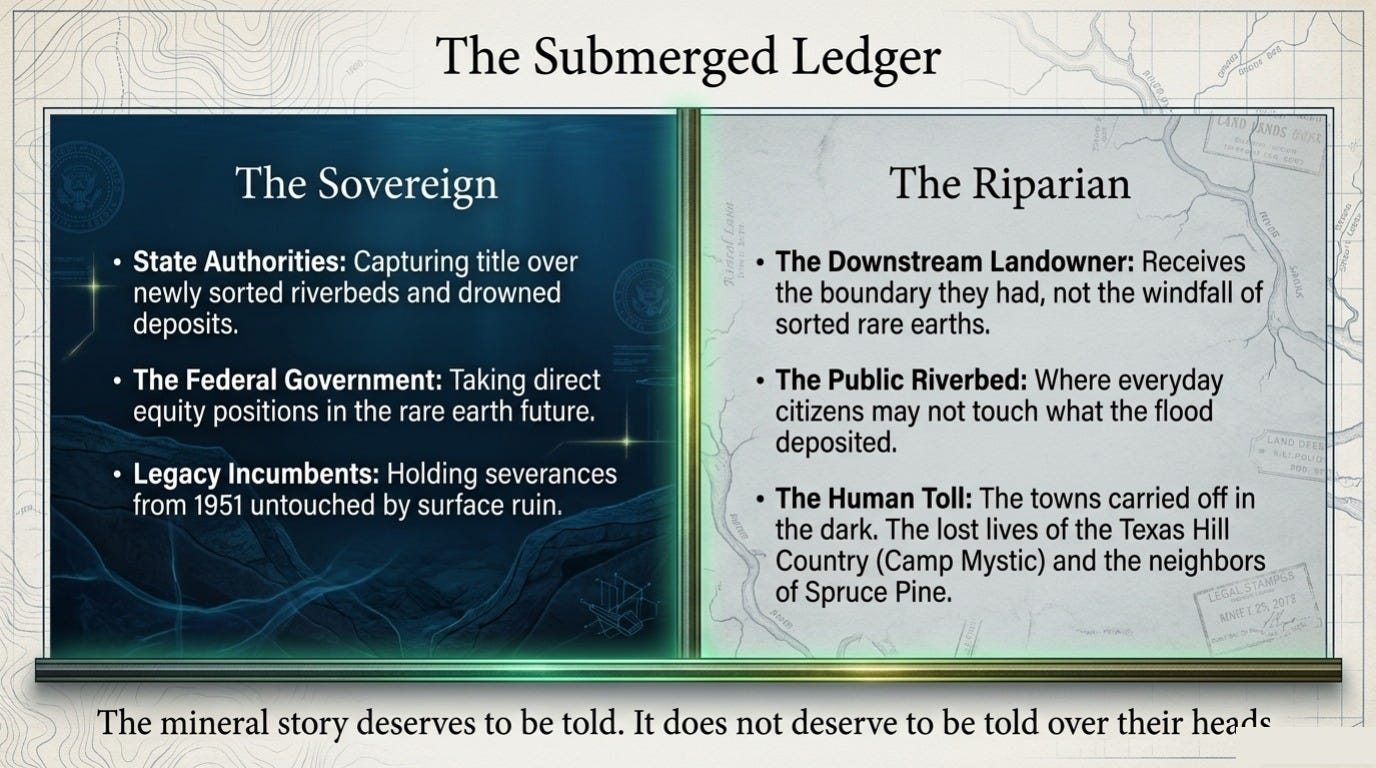
And July of 2026 wrote the ledger’s plainest page. The largest water in years moved through the basin, the smallest toll in years was taken from the people, and when it was done the sovereign’s two reservoirs stood full for the first time in seven years and every gate on the chain had run. No one seized anything. No one needed to. The machinery simply did, at scale and in public and inside a single week, what this account has argued it always does. It received.
And who lost. The people in the river. The downstream owner whose land catches a fortune in sediment the flood has sorted, and who learns that the law of sudden water gives him the boundary he had and not the windfall that landed on it. The riparian holder who may not touch what the flood deposited in the public bed. The town carried off in the dark. It is worth saying, plainly and without ornament, that the deepest loss in any of this is not a loss of mineral rights. It is the loss counted in the children of Camp Mystic and the neighbors of Spruce Pine and every person these waters took. The mineral story is real and it deserves to be told. It does not deserve to be told over their heads.
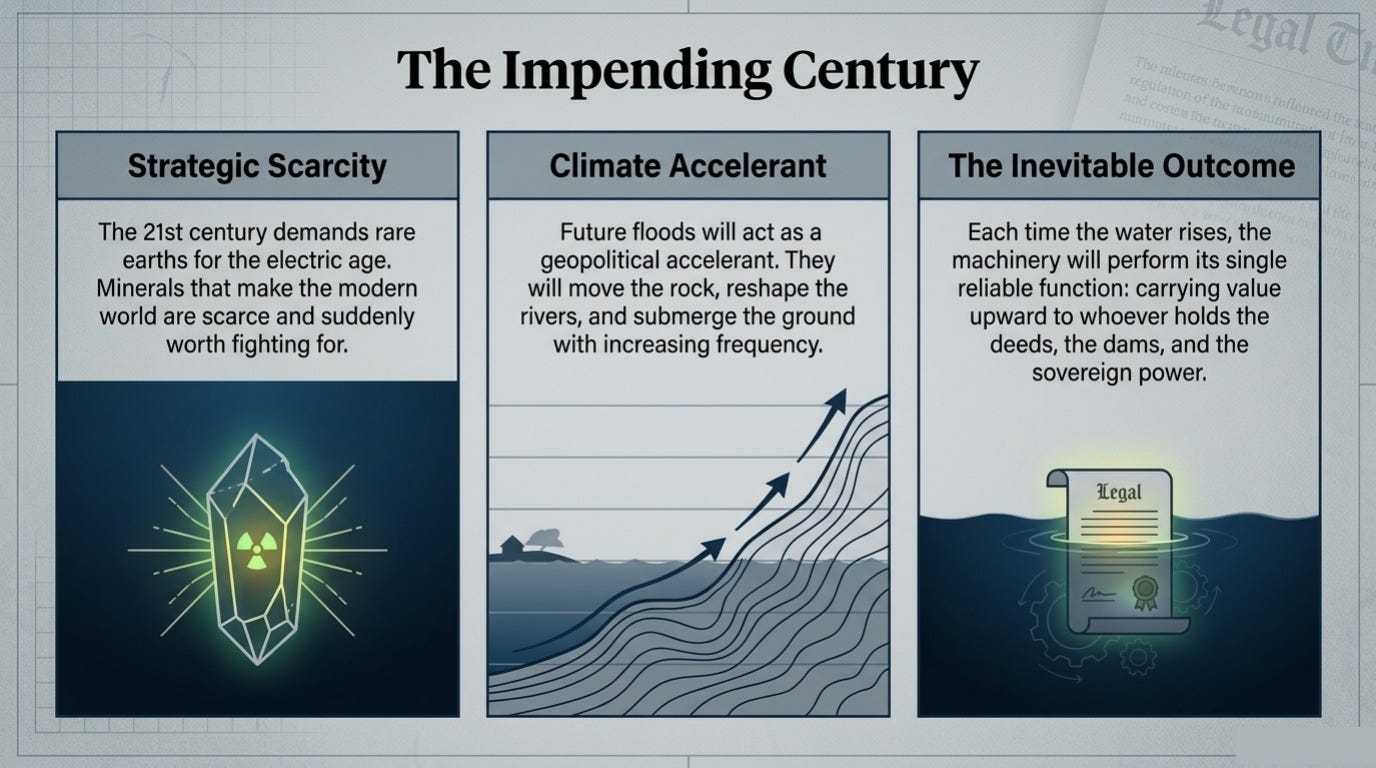
But it should be told, because it explains something about the country that the obituaries and the recovery dispatches cannot. We are entering a century in which the minerals that make the modern world are scarce, strategic, and suddenly worth fighting for, and the question of who is permitted to own them is being decided right now, in statutes and reservoirs and federal stock purchases, mostly out of public view. The floods are a kind of accelerant. They move the rock. They reshape the rivers. They submerge the ground. And each time they do, the quiet machinery beneath the surface performs its single reliable function, which is to carry the value upward, into the keeping of whoever already holds the deeds and the dams and the sovereign power to lease what lies beneath the water.
Edison understood the value of that hill in 1889. The water understood it better. Somewhere under Lake Buchanan it is still down there in the dark, one of the greatest rare earth deposits ever found in America, held now by the State of Texas, visited only by the fish and by the occasional treasure hunter with a radiation counter who has read the old reports and gone walking the shoreline for what the water did not quite manage to swallow.
The rest of us pass over it without knowing, which is exactly how the machinery prefers things. The water is the oldest force in the story, and it has always been the quietest lawyer in the room.
Notes on Sourcing
The account of Barringer Hill draws on the United States Geological Survey’s mineral deposit record for the site, which describes the pegmatite as covered by Lake Buchanan in 1937, and on the mineralogical literature of the period, including William Hidden’s reports on the Llano County pegmatite. The history of the dam, and of the federal funding condition that required a public agency owned by the State of Texas, follows the founding record of the Lower Colorado River Authority and the reservoir documentation of the Texas Water Development Board.
The Carolina monazite belt is documented in the Survey’s mid century studies of southeastern placers and in the North Carolina Geological Survey’s commodity files; the detail that placer operations were extended by flood borne gravel comes from the historical mine records of the belt. The severance beneath roughly forty one percent of Mitchell County, sold at auction in 1951, is a matter of recorded deed. The geology of the Llano Uplift and the Blue Ridge, and the hydraulic behavior of heavy minerals in flood, follow standard economic geology and the Survey’s own assessment method.
The federal critical minerals actions of 2025, including the Defense Department’s equity stake in the nation’s principal rare earth producer, the North Carolina magnet investment, and the status of the Round Top project on Texas state land, are drawn from the companies’ securities filings and contemporaneous reporting. The legal treatment of navigable streambeds and sudden avulsion follows established Texas and North Carolina authority. Figures for production, acreage, and depth are stated conservatively against the documentary record. The human toll of the 2024, 2025 and 2026 floods is reported as confirmed by state and federal authorities.
The shared Grenville origin of the Llano Uplift and the southern Appalachian basement, and the placement of both in one accretion along the ancient southern margin of the continent, follow the geological literature on the Grenville orogeny, including the work of Sharon Mosher and colleagues and the standard surveys of Texas and Appalachian basement. The composition of monazite, its content of thorium and trace uranium, the use of airborne gamma ray spectrometry to map rare earths by their thorium signature, and the thorium burden that complicates domestic processing are drawn from the mineralogical and economic geology literature, the World Nuclear Association’s material on naturally occurring radioactive minerals, and the United States Geological Survey’s mapping program. The fertility of thorium as a reactor fuel is a matter of standard nuclear physics.
The account of the plant at Erwin draws on the Nuclear Regulatory Commission’s licensing and decommissioning records, the company’s own statements and the regulator’s event reports from the September 2024 flooding, contemporaneous local reporting on the destroyed warehouse and the recovered containers, and the published isotopic study of enriched uranium in the Nolichucky and the lake downstream, conducted for the Sierra Club. The 2025 contract to rebuild a domestic uranium enrichment capacity beside the plant follows the announcements of the company and the National Nuclear Security Administration. The broader federal program of 2025 and 2026, including the conversion of grants into equity in several producers, the strategic minerals reserve, the refilled national stockpile, and the February 2026 ministerial, follows official releases and securities filings. The conspiracy claims described in these pages, that the storms were engineered to seize minerals, are addressed as the widely circulated misinformation they are, and have been refuted by atmospheric scientists, by federal and state officials of both parties, and by the plain facts of geography and physics.
The account of the July 2026 flood follows the City of Kerrville’s flood recovery record, contemporaneous reporting by the Texas Tribune and the Austin and San Antonio stations on the event and on the siren and camp safety reforms enacted after 2025, and the gauge record of the National Weather Service and the river authority’s Hydromet for the crests at Junction, Mason, Llano, Center Point, Hunt and Uvalde. The filling of lakes Buchanan and Travis across the two summers, the floodgate operations at Mansfield and Buchanan dams, the characterization of the event as the region’s most significant flooding since 2018, and the description of the reservoirs as replenished by floods are drawn from the Lower Colorado River Authority’s own news releases and public statements of July 2025 and July 2026.
Travis Spencer · Real Estate Mindset · Independent
Very good article really an amazing story laid out in real life. What you have you may not keep. The Sovereignty of God must be recognized.